

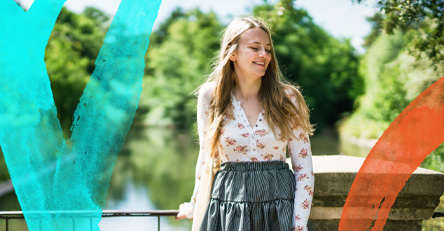
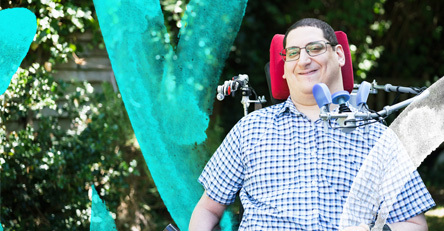


Gabby Rolls – Comedian, Campaigner, and Cerebral Palsy Champion – is 21, a recent university graduate, a boccia national champion, and a wheelchair-using stand-up comic with a wicked sense of humour.
She’s also someone with deep insight into what it means to grow up disabled in a world that rarely expects disabled people to be ambitious, independent, or loud. But Gabby is all of those things – and more.
Her story doesn’t begin at a defining moment or end with a clean triumph. Instead, it’s shaped by resilience, learning, and a powerful refusal to apologise for living life differently. Gabby’s sharing her truth not to inspire, but to inform – and to demand the kind of inclusion we all deserve.
“They Said I Might Never Walk or Talk…”
Gabby was born three months early. “I was starved of oxygen at birth, which caused my CP,” she explains. As a twin, the differences between her and her brother quickly became apparent. “When he started hitting milestones and I didn’t – that’s when my mum knew something was up.”
She was diagnosed with spastic diplegia, a form of cerebral palsy that affects both legs – and, in Gabby’s case, also her hands. “Doctors said I might never walk or talk. It was very ‘wait and see’.”
From a young age, disability shaped every part of Gabby’s routine. “My childhood was full of appointments – physio, hydro, speech therapy, orthopaedics. But I had a really happy childhood. My parents never hid my disability. They just found ways to make things work.”
After a major hip surgery at 12, Gabby became a full-time electric wheelchair user. Now, she lives independently with 24/7 care and a team of personal assistants. “Everything from showering to food prep to getting dressed – I need support with all of it,” she says. “But that doesn’t mean I don’t live a full life.”
The Cliff Edge at 18
Up until adulthood, Gabby was well-supported through paediatric care. But once she hit 18, everything changed.
“You hear people talk about the cliff edge – and it’s real. I went from having regular therapy and surgeries to being completely discharged.” Gabby’s last major surgery was at 14. Now, despite chronic pain and scoliosis, she’s four years overdue for a recommended X-ray.
“I’m only under the chronic pain team now – and even they don’t know what to do with me. They’ve changed my meds, sent me for equipment… but mostly, I’m just in pain. And that’s that.”
Systems That Punish You for Trying
Financial support has been another uphill battle. “I qualify for the higher rate of Personal Independence Payment (PIP), which is a huge relief. But Universal Credit? That’s a mess.”
As a student, Gabby received Universal Credit due to being classed as having “limited capability for work.” But now that she’s job-hunting, the very act of trying to work risks removing the safety net she relied on.
“If I take a part-time role – which is all I can manage right now – they start clawing back the benefit. It’s like you’re punished for working.”
She’s grateful her parents are accountants and can help her understand the system. “But most people don’t have that. And it shouldn’t take financial expertise to access the support you need to live.”
Life, Work, and Comedy
Gabby’s currently job-hunting, with a clear focus: she wants to work in the Equality, Diversity and Inclusion (EDI) space. “I’ve been volunteering in inclusion roles for a while. Disability is my lived experience, but I also care about women’s rights, LGBTQ+ inclusion, race equity. I want to help organisations be better.”
Gabby is now working full time with Kent Cricket as an EDI project officer.
And in between all that? Gabby performs stand-up comedy.
“I started it on a whim – a New Year’s resolution – and now I’m hooked.” Performing under the Instagram handle @cerebralrollsy, Gabby delivers sharp, unapologetic material about life, disability, and everything in between. “I think disabled people have some of the best dark humour out there. It’s how we survive.”
What Inclusion Really Looks Like
For Gabby, inclusive spaces don’t just accommodate – they welcome. One of those spaces was boccia, a precision sport she began playing after surgery at age 12. “It was the first time I didn’t feel like the odd one out. Everyone had something going on – and nobody questioned it.”
Nine years later, she’s a national champion in her category.
But not all experiences have been so positive. In secondary school – an all-girls grammar where she was the first full-time wheelchair user – Gabby says she wasn’t bullied, but she was often invisible.
“My peers didn’t know how to approach me. They were scared of saying the wrong thing, so they didn’t say anything at all.”
She believes this comes down to a lack of awareness – in schools, in workplaces, and in media. “People assume disability means low intelligence or high maintenance. They see us as more effort than we’re worth.”
Redefining “Effort”
“I get it,” Gabby says. “I’m not the ‘easy’ option. I need an accessible building. I might need adjustments. But that doesn’t mean I’m not worth it.”
She’s clear that inclusion isn’t just about logistics. “When people meet me, they immediately go to what I can’t do. I want them to focus on what I can – because there’s a lot.”
Advice to Young Disabled People
Asked what she’d tell her younger self – or any disabled young person reading – Gabby doesn’t hesitate.
“Own your story. Own your circumstances. Don’t feel the need to justify why you do things differently.”
“CP is a spectrum, and everyone experiences it differently. You are not a burden. You’re not less. And the people who are meant to be in your life will accept you as you are.”
What’s Next?
Gabby’s future is wide open. Whether she’s campaigning for access, cracking jokes on stage, or transforming EDI strategies – one thing is clear: she’s not waiting for permission to take up space.
And the world’s better for it.