


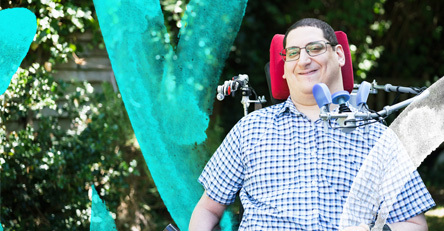



Ashley Dalton MP, Parliamentary Under Secretary for Health and Social Care
The parliamentary response on support for adults with cerebral palsy highlights the gap between policy ambition and lived reality, says UP Co-founder and CEO, Emma Livingstone
For decades, adults with cerebral palsy (CP) have faced fragmented care, limited access to specialist expertise and no consistent expectations around annual reviews or long-term oversight. Much of this inequity has stemmed from the long-standing misconception that CP is primarily a childhood condition.
The Department of Health and Social Care’s recent acknowledgement that cerebral palsy is, in fact, a lifelong condition marks a watershed moment. But recognition alone does not close the inequity gap. The scale of the challenge is clear.
There are 130,000 adults with CP in the UK – comparable in size to the populations of adults living with multiple sclerosis or Parkinson’s disease – yet without access to equivalent, structured pathways of care. The consequences are profound and avoidable: adults with CP are 14 times more likely to die from respiratory disease, three times more likely to die from cardiovascular disease, and experience nearly six times more falls than adults without CP. These outcomes are not an inevitability of the condition; they are the result of systemic oversight.
A moment for change
NHS England’s Strategic Commissioning Framework, published in November 2025, requires all 42 Integrated Care Boards (ICBs) to:
- • Prioritise prevention and early intervention for identifiable at-risk groups
- • Complete integrated needs assessments by March 2026
- • Work in genuine co-production with lived-experience organisations
- • Establish evaluation frameworks by March 2027
Adults with CP meet every one of these criteria – yet have been consistently absent from commissioning priorities.
When Ashley Dalton MP, Parliamentary Under Secretary for Health and Social Care, was asked about support for adults with CP, she referenced the NHS England commissioning framework for children and young people with cerebral palsy. That framework, which focuses on the under-25s, acknowledges the need for transition planning and coordinated care pathways.
But adults with CP – those over 25 – need the same systematic approach. The Strategic Commissioning Framework provides the mandate for ICBs to identify priority populations and commission appropriate services. Adults with CP clearly qualify: they are an identifiable at-risk group with complex, interconnected needs that require specialist multidisciplinary teams, coordinated care pathways and regular reviews.
What this means in practice
If ICBs were to prioritise adults with CP under the Strategic Commissioning Framework, they would need to commission:
- •Regular reviews of clinical and functional needs
- • Clear, integrated care pathways
- • Access to multidisciplinary teams and specialist neurology services
- • By 2027, personal care plans for those with complex needs, underpinned by joined-up neighbourhood teams
Structured Annual Reviews represent the practical next step
NICE guideline NG119 already recommends regular reviews for adults with CP delivered by professionals with neurodisability expertise, yet these are rarely implemented in practice. A structured Annual Review model – like that already established for adults with learning disabilities – would provide:
- • early identification of respiratory, cardiovascular and musculoskeletal risk,
- • coordinated management across primary and specialist care,
- • continuity through a named consultant,
- • reduced emergency admissions, and
- • tangible improvements in quality of life and participation.
Crucially, Annual Reviews offer ICBs a ready-made delivery mechanism for their Strategic Commissioning Framework duties.
At UP – The Adult Cerebral Palsy Movement, we believe this is the moment for meaningful change
Our work on the Strategic Commissioning Framework shows that the tools already exist: prevention, population health management, life-course commissioning and co-production. These levers can only work, however, if adults with CP are intentionally included.
UP stands ready to partner with commissioners, policymakers and national bodies to translate recognition into action. Together, we can create the lifelong, joined-up care that adults with CP both deserve and are now-finally-recognised as needing.
If we seize this moment, the next decade could be the first in which adults with cerebral palsy experience equity, not oversight.
With just 13 months to achieve this ambition, the gap between intention and implementation must now close.