





This article appears in the Summer 2026 issue of the BACD newsletter. Emma has also been invited to give a keynote at the next BACD conference in March.
For more information about Transition, please visit our dedicated section.
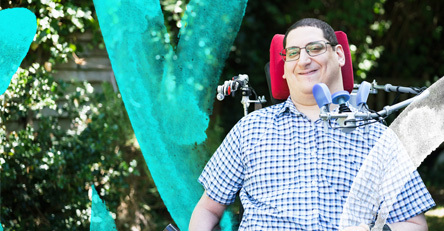
Emma Livingstone, co-founder of UP – The Adult Cerebral Palsy Movement, on a healthcare gap that begins the moment paediatric teams say goodbye.
The theme of this year’s European Academy of Childhood Disability conference – ‘Encourage the young and they will flourish’ – stayed with me long after I heard it. Because I have spent the last decade watching what happens to the young people you encourage, the ones who do flourish, once they turn 18 and leave children’s services.
I have cerebral palsy. I had excellent paediatric care. I was encouraged and supported, and I flourished – into adulthood, into a career, into a life. Then, in my late thirties, my mobility declined significantly. Hip surgery. A long recovery. And at the moment I most needed coordinated medical support, I found there was almost none to be had. My GP felt under- confident managing CP. Adult services didn’t quite know what to do with a ‘childhood diagnosis’. I navigated a system that hadn’t been built with me in mind. That experience – frustrating, frightening, and wholly unnecessary – became a blog post called ‘From Complainer to Campaigner’, and eventually became UP: The Adult Cerebral Palsy Movement.
What I didn ‘t realise at the time was how ordinary my experience was. We now know that only 5% of adults with CP are referred to specialist neurological services. Adults with CP are almost 14 times more likely to die from respiratory disease, and nearly six times more likely to experience falls. These are not obscure statistics. They describe what happens when a lifelong condition is treated as though it ends at 18.
A gap that begins at discharge
Cerebral palsy is the most common physical disability in childhood and one of the most common in the UK overall, affecting approximately 130,000 adults. The NHS itself categorises it as a long-term condition. And yet annual health checks for adults with CP are not mandated. If you are under 50, they are not available at all. If you are over 50, whether you receive them depends entirely on your individual GP.
Most adults tell us the same story: paediatric services end, often without a transition plan, and what follows is a patchwork of ad hoc care, gaps, and confusion. GPs – many of them excellent, conscientious clinicians – tell us they feel under-confident and under-resourced when it comes to managing CP in adults. They don ‘t know what the relevant deterioration patterns look like. They don ‘t always know where to refer. They often don ‘t have enough time. The result, as one of the adults we interviewed put it, is that ‘the system decided my CP had disappeared’. It hasn’t disappeared. It has changed. And the changes – increasing pain, fatigue, declining mobility, mental health challenges – are often preventable or manageable with the right support at the right time.
The Doctor Won’t See Us Now
That’s why UP launched our ‘The Doctor Won’t See Us Now campaign and the associated GPs for CP initiative, calling for the NHS to mandate annual health checks for all adults with CP and to provide GPs with the clinical guidance and referral pathways they need to manage the condition confidently. What we are asking for is not complex or expensive. We want annual reviews that recognise CP as the lifelong condition it is, catching deterioration before it becomes crisis. We want clear clinical guidance for GPs on how CP presents and progresses in adults. We want defined referral routes to community neurology and rehabilitation services. We want longer appointments where communication or cognitive needs require them.
We also want to see cerebral palsy explicitly recognised within the NHS Strategic Commissioning Framework and within Integrated Care Board (ICB) neurology specifications. Too often, adults with CP fall between services because no part of the system is clearly responsible for commissioning their care. Embedding CP within neurological service specifications would help ensure consistent pathways, clearer accountability, and equitable access to specialist rehabilitation and community neurology support, regardless of where someone lives.
These changes are not about creating entirely new services. They are about making sure that existing systems recognise cerebral palsy as the lifelong neurological condition it is and commission care accordingly.
Some of you will already have patients you are thinking of in this context. Young adults who are ageing out of your caseload, or whose families you know will struggle to navigate the adult system. You are in an important position, not because you are responsible for adult services – you are not – but because what happens at the moment of transition matters enormously. A discharge summary that names CP as a lifelong condition, that clearly describes support needs, that includes a referral to adult neurology or rehabilitation where one exists, makes a real difference to what comes next.
What good can look like
We have been fortunate to work with Professor Siva Nair, a consultant neurologist in Sheffield who has built what is currently one of the only specialist adult CP clinics in the UK. He now sees nearly 250 adults with CP, offering long-term monitoring, annual reviews, and holistic care. His description of what happens without services like his is candid: ‘When they become adults, because we don ‘t have expertise, we don ‘t have experience looking after them, they are new to us. The holistic care that they received in children’s hospitals gets fragmented into silos of experts who don’t collaborate’. One of his patients told us simply: ‘I’m glad to have cerebral palsy in Sheffield’. Nobody should have to be that lucky. Professor Nair’s model is replicable. It doesn’t require a separate building or unlimited resources. It requires a named clinician, a link to a prescribing physiotherapist, and the understanding that CP in adults needs long-term monitoring, not episodic crisis management.
What you can do
UP has developed resources specifically for clinicians and GPs who want to support their adult patients with CP, including a community neuro team lookup tool that makes visible the specialist services that do exist, region by region, across the UK. Many of our adult community members report that when they showed this tool to their GP, it opened a conversation that simply hadn’t been possible before.
We would love to connect with more paediatric professionals who share our concern about what happens to the young people they have supported for years. If you are involved in transition planning, in policy, or in training the next generation of GPs and paediatricians, the message we would ask you to carry is this: cerebral palsy does not end when your care does. The children you encourage and help flourish grow up. They deserve a system that is ready for them.
Find out more, access clinician resources, and sign up to support the campaign at https://upmovement.org.uk/.
EMMA LIVINGSTONE is co-founder of UP – The Adult Cerebral Palsy Movement (upmovement.org.uk), the UK’s only charity exclusively supporting adults with cerebral palsy. UP is free to join.